Ever felt a step behind when the term ‘JDM’ pops up at a car meet? You see a pristine Nissan Skyline or a souped-up Honda, and you know it’s special, but the line between a car made in Japan and a true JDM legend feels blurry. That’s because the world of jdm cars is more than just a label; it’s a deep-rooted culture built on engineering mastery, bold innovation, and a unique automotive philosophy that set the world on fire.
So, what does JDM actually mean? And why do these machines—from the fire-breathing Godzilla to the nimble AE86—command such fierce loyalty and global reverence? Get ready to go beyond the hype. In this passionate guide, we’re demystifying the jargon, exploring the history that forged these icons, and introducing you to the legendary models that didn’t just redefine performance—they created a worldwide movement. By the time you’re done, you won’t just understand JDM; you’ll feel the passion that drives it.
What Does JDM *Actually* Mean? (It’s More Than a Sticker)
You’ve seen the sticker slapped on the back of a lowered Civic, you’ve heard the term thrown around at car meets, but what is the real story behind the JDM legend? Let’s cut through the noise. In its purest form, JDM stands for Japanese Domestic Market. This isn’t just a label for any car from a Japanese brand; it refers specifically to vehicles built and sold *exclusively* for the roads of Japan.
Think of it like this: you can get a “California Roll” anywhere in the world, but it’s an export designed for a global palate. True, authentic sushi in a Tokyo fish market is an entirely different experience, made for locals. That’s the JDM philosophy—an unfiltered expression of Japanese automotive engineering.
The Core Definition: Built for Japan’s Roads
These cars are a direct reflection of their homeland. They were engineered to meet the unique demands of Japanese drivers and the strict regulations of the country’s transportation bureaus. The most obvious giveaway? The steering wheel is on the right side (RHD) to suit Japan’s left-side traffic flow. But it goes deeper. These vehicles often featured different engine variants, tech, and styling not available anywhere else, all tailored to the Japanese Domestic Market. The ultimate example is the ‘Kei car’—a microcar with engine and size restrictions so tight it could only exist and thrive in Japan’s congested urban landscape.
Common Misconceptions Debunked
So, is that shiny new Honda Civic Type R you bought from a US dealership a JDM car? The short, passionate answer is no. While it’s a masterpiece of Japanese engineering, it was built for the United States Domestic Market (USDM). True jdm cars are models like the Nissan Skyline GT-R R34 or the Honda Civic Type R (EK9)—legends that were never officially sold new in the US and had to be imported.
This is where we get the popular term “JDM-style.” This refers to modifying a USDM car with authentic parts—like engines, bumpers, or headlights—from its Japanese counterpart to capture that exclusive aesthetic and performance. It’s a tribute, a nod to the real thing, but the car’s soul (its chassis and VIN) remains tied to the market it was born for.
The Golden Era: How JDM Cars Became Global Legends
Ever wonder how Japan, in just a couple of decades, managed to produce some of the most legendary sports cars the world has ever seen? The answer lies in a perfect storm of economic might and fierce creative rivalry known as the ‘Bubble Era’ of the late 1980s and 1990s. This wasn’t just a period of prosperity; it was an automotive renaissance that unleashed a wave of engineering marvels that still captivate us today.
Economic Power Fuels Automotive Dreams
During the Bubble Era, Japan’s economy was soaring, and its car manufacturers had R&D budgets that seemed limitless. The mission wasn’t to build the most affordable car—it was to build the absolute best. This ambition ignited an intense rivalry between brands like Nissan, Toyota, Honda, and Mazda, each trying to out-engineer the other. The result was an explosion of advanced technology in road cars, including:
- Complex All-Wheel Drive Systems: Think Nissan’s legendary ATTESA E-TS in the Skyline GT-R.
- Twin-Turbocharging: The heart of icons like the Toyota Supra (2JZ-GTE) and Mazda RX-7 (13B-REW).
- Four-Wheel Steering: Found in cars like the Mitsubishi 3000GT VR-4 and Honda Prelude.
The ‘276 HP’ Myth and Engineering Excellence
Here’s where the story gets fascinating. Amidst this power war, Japanese manufacturers entered a ‘Gentleman’s Agreement’ to limit advertised horsepower to 276 HP (280 PS). But was it real? Not exactly. Many of the era’s most iconic jdm cars, like the R34 Skyline GT-R and Mk4 Supra, produced well over 300 HP straight from the factory. This unwritten rule had a brilliant, unintended consequence: it forced engineers to chase perfection beyond the engine bay. With power officially capped, the focus shifted to creating a sublime driving experience through superior handling, chassis balance, and driver feedback.
This obsessive focus on the total driving experience is a key reason behind the Worldwide Influence of Japanese Automobiles, creating a legacy that continues to inspire tuners and collectors today. They weren’t just building fast cars; they were crafting automotive soul.
The Icons: 10 JDM Cars That Defined a Generation
Some vehicles are more than just metal, rubber, and glass—they’re legends. They are the titans that defined an entire era of automotive passion and engineering prowess. These are the machines that come to mind when enthusiasts ask what are JDM cars, each one a hero with a story to tell. Let’s dive into the icons that made the Japanese Domestic Market a global phenomenon.
The Titans of JDM Performance
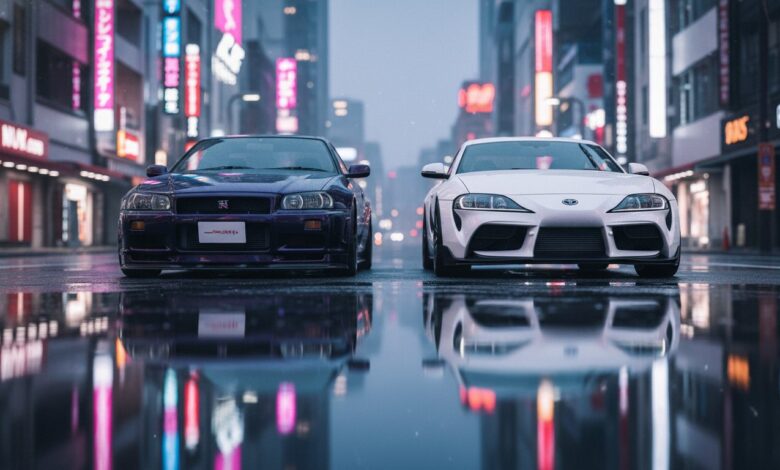
- Nissan Skyline GT-R (R32/R33/R34) – ‘Godzilla’: A technological monster that devoured supercars on the track. Its advanced all-wheel-drive system and twin-turbo RB26 engine were so dominant in motorsport that it earned its fearsome nickname fair and square.
- Toyota Supra (A80): The legend with a heart of gold—or rather, a block of iron. The A80’s near-indestructible 2JZ-GTE engine became a tuner’s dream, while its iconic, sweeping body lines made it a superstar on the street and the silver screen.
- Honda NSX: The everyday supercar. Co-developed with Formula 1 legend Ayrton Senna, the NSX combined exotic looks and a mid-engine layout with Honda’s signature reliability. It was a masterpiece of balance and precision engineering that challenged European elites.
- Mazda RX-7 (FD): A symphony of curves and revs. The FD RX-7 is automotive art, boasting a unique twin-turbo rotary engine and one of the most perfectly balanced chassis ever created. Driving one is a pure, unfiltered connection between car and driver.
- Mitsubishi Lancer Evolution & Subaru Impreza WRX STI: The eternal rally rivals. Born from dirt and gravel, these two all-wheel-drive, turbocharged sedans brought world-class rally performance to the streets. Their fierce competition fueled an arms race that benefited every single enthusiast.
Cult Classics and Driver’s Favorites
- Honda S2000: A high-revving masterpiece. With a redline that screamed past 9,000 RPM, the S2000 was a roadster built for pure driving bliss. It offered one of the most engaging, top-down experiences of all time.
- Nissan Silvia (S13/S14/S15): The heart of drifting. Lightweight, rear-wheel-drive, and endlessly tunable, the Silvia platform became the quintessential canvas for the art of going sideways. It’s the undisputed king of the drift scene.
- Acura Integra Type R: The pinnacle of front-wheel-drive performance. Honda stripped it down, stiffened it up, and dropped in a hand-built engine. The result? A razor-sharp handler that proved FWD jdm cars could dominate on the track.
- Toyota AE86 Corolla: The humble hero. Known as the ‘Hachi-Roku,’ this lightweight Corolla became a legend thanks to the anime Initial D. It’s the ultimate underdog story, proving that perfect balance and driver skill can triumph over raw power.
JDM vs. The World: What’s the Real Difference?
So, you think the only difference is a steering wheel on the “wrong” side? Think again. The obsession with importing a car from halfway around the world goes far beyond a simple right-hand-drive novelty. It’s about accessing a purer, more potent version of a vehicle that was often diluted for international markets. This is the real reason enthusiasts go through the trouble; it’s a quest for authenticity.
Performance and Engine Variations
This is where the magic truly happens. Japanese engineers often saved the best for their home market. JDM models frequently received higher-revving engines, more aggressive cam profiles, and different turbo setups. A legendary example is the DC2 Honda Integra Type R; the JDM version’s B18C engine produced nearly 200 horsepower with a screaming 8,400 RPM redline, a noticeable jump from its US counterpart. Beyond that, entire high-performance trims like Subaru’s Impreza WRX STi Type RA and Spec C were never officially exported, offering a raw, track-focused experience that was pure, unfiltered JDM.
Aesthetic and Equipment Differences
It wasn’t just about what was under the hood. Automakers in Japan often fitted their domestic models with unique and more aggressive styling. This could mean:
- Exclusive Body Kits: Sharper front lips, taller spoilers, and sleeker side skirts.
- Distinctive Lighting: Different headlight and taillight designs that became coveted items for global tuners.
- Advanced Tech: Features like digital climate control or advanced navigation systems often appeared in Japan years before they were offered elsewhere.
This “forbidden fruit” appeal creates a powerful allure, making these jdm cars feel more special and exclusive than their globally available siblings.
The 25-Year Import Rule Explained
So, how do these icons reach American shores? The answer is the “25-Year Import Rule.” In the United States, a motor vehicle that is at least 25 years old can be lawfully imported without needing to comply with modern Federal Motor Vehicle Safety Standards. This law is why the late 80s and 90s are considered the golden era for importers right now. Each year, a new wave of legendary machines—from the Nissan Skyline GT-R to the Toyota Supra—becomes eligible, finally unleashing them onto US roads. It’s important to note this is a US-specific law; other countries like Canada have a 15-year rule, creating different waves of import eligibility.
Ready to see which JDM legends have just become legal? Explore our latest features and buyer’s guides at revandtorque.com!
The JDM Culture Today: A Global Phenomenon
The passion for Japanese Domestic Market vehicles didn’t fade with the end of Japan’s “Bubble Era.” Instead, it ignited a global fire that burns brighter than ever today. The engineering mastery and bold designs of the ’80s and ’90s laid the foundation for a culture built on creativity, performance, and a deep sense of community. But how did this uniquely Japanese movement capture the hearts of enthusiasts worldwide? The answer lies in a perfect storm of digital media and raw automotive passion.
From Gran Turismo to The Fast and the Furious
For many, the first taste of JDM magic wasn’t on a street or track—it was on a screen. Video games like Gran Turismo put legendary machines like the Nissan Skyline GT-R and Toyota Supra into the virtual garages of millions. Suddenly, kids across the globe knew the specs and tuning potential of cars they had never seen in person. This digital obsession was supercharged by Hollywood with The Fast and the Furious, which catapulted JDM tuning culture into the mainstream. At the same time, anime like Initial D romanticized the art of drifting on mountain passes, inspiring a generation to master the art of the slide.
The Tuning Scene: Drifting, Time Attack, and Stance
At its core, JDM culture is about personalization. These cars were built with such robust engineering—think the legendary 2JZ-GTE or RB26DETT engines—that they became perfect blank canvases for modification. This has given rise to vibrant and diverse subcultures:
- Drifting: The spectacular art of controlled oversteer, where style and precision are just as important as speed.
- Time Attack: A pure expression of performance, where tuners obsessively chase the single fastest lap on a racetrack.
- Stance: An aesthetic-driven movement focused on achieving the perfect harmony of ride height, wheel fitment, and aggressive posture.
More than just cars, the JDM scene is a global community connected by a shared passion for innovation and self-expression. The legacy of these incredible jdm cars lives on not in museums, but in the garages and on the tracks where enthusiasts continue to push the limits. The story of JDM is a thrilling chapter in automotive history. Explore more iconic sports car stories on Rev and Torque!
More Than Metal: The Heartbeat of JDM
From the true meaning of the Japanese Domestic Market to the golden era that gifted us legends like the Skyline and Supra, it’s clear that JDM is far more than just a sticker on a window. It’s a philosophy—a commitment to engineering excellence and a culture of passionate innovation that has captured the hearts of enthusiasts across the globe. These machines weren’t just built; they were born from a unique automotive spirit.
The world of jdm cars is a deep and rewarding rabbit hole, and the passion they inspire is universal. At Rev and Torque, we live for that thrill. As your source for honest, engaging automotive content, we bring you expert analysis from passionate enthusiasts. Trusted by a global community of car lovers, we’re here to help you understand what makes a performance car truly special. Ready to go deeper? Dive into our Ultimate Sports Car Performance Guide! Keep chasing that perfect line, and never stop celebrating the machines that move us.
Frequently Asked Questions About JDM Cars
Is my Japanese-brand car (like a Honda or Toyota) automatically a JDM car?
That’s a common misconception! JDM stands for Japanese Domestic Market, meaning the car was built specifically for sale *in Japan*. A Honda or Toyota sold new in the USA is a USDM (US Domestic Market) vehicle. True JDM cars often have different engines, features, or even entire models—like the Nissan Skyline GT-R—that were never officially sold elsewhere. This exclusivity is a huge part of their incredible appeal to enthusiasts worldwide.
Why are all JDM cars right-hand drive?
It all comes down to the rules of the road. In Japan, they drive on the left side, so their cars are manufactured with the steering wheel on the right (right-hand drive, or RHD) for driver visibility. This is one of the most defining and authentic characteristics of a JDM import. Getting behind the wheel of an RHD car is a core part of the unique, immersive experience that makes owning these machines so thrilling.
Is it legal to own and drive a JDM car in the USA?
Absolutely, but there’s one massive condition: the vehicle must be at least 25 years old. Once a car hits this magical milestone, it becomes exempt from the Federal Motor Vehicle Safety Standards (FMVSS) and EPA regulations it wasn’t originally designed to meet. This “25-Year Rule” is the key that unlocks the door for importing and legally registering some of Japan’s most legendary automotive creations on American roads.
What is the ’25-Year Rule’ for importing cars?
The “25-Year Rule” is the golden ticket for American car enthusiasts. Officially the Imported Vehicle Safety Compliance Act, it allows vehicles 25 years or older (to the month of manufacture) to be legally imported without needing to meet modern US safety or emissions standards. This is precisely why the late 80s and 90s are a golden era for importation, unleashing a wave of iconic JDM cars like the Mazda RX-7 and Subaru WRX STI onto our shores.
Are JDM cars more reliable or better than their US-market counterparts?
While “better” is subjective, JDM models often packed a bigger punch. Due to fierce competition in their home market, Japanese automakers frequently saved their best for last, equipping JDM versions with higher-performance engines, more aggressive tuning, and advanced tech not offered elsewhere. For example, many JDM turbocharged engines had higher horsepower ratings than their detuned export versions. This pursuit of performance is what gives them their legendary status.
What is a ‘Kei car’ and is it considered JDM?
Yes, Kei cars are the purest expression of JDM! They are a unique class of tiny vehicles in Japan, built to strict size and engine (under 660cc) regulations for tax and insurance benefits. But don’t let their size fool you; this category spawned some incredibly fun and innovative machines, from micro sports cars like the Honda Beat to rugged mini-SUVs like the Suzuki Jimny. They are a fascinating, fun-sized slice of Japanese automotive ingenuity.